How to Split Bills Fairly When Incomes Differ
Aug 7, 2026
Most advice about splitting expenses with a partner starts with the same assumption: divide everything in half.
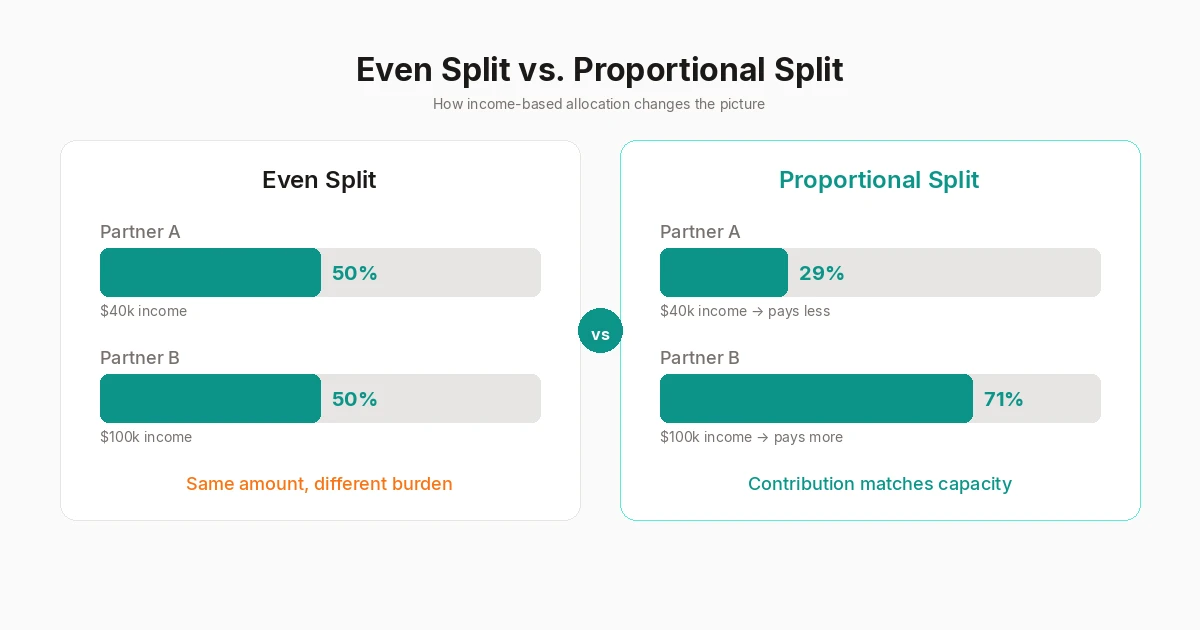
It sounds fair. Clean math, no ambiguity, no arguments. But when one partner earns $40,000 and the other earns $100,000, a 50/50 split can carry very different weight. The lower earner might be stretching after rent, groceries, and transportation. The higher earner might barely notice.
If that gap has been quietly building tension in your household, you are not alone. Proportional splitting is an alternative that scales each partner's contribution to their income, not an arbitrary even line.
This post explains how it works, walks through the math, and covers how to set it up with your partner.
Why 50/50 splitting often isn't fair
Equal does not always mean equitable. The difference shows up quickly in practice.
Take a couple where one partner earns $40,000 a year and the other earns $100,000. Their shared monthly expenses total $2,500 (rent, utilities, groceries, insurance). Under a 50/50 split, each pays $1,250.
For the higher earner, that $1,250 is about 15% of their gross monthly income. For the lower earner, it is more than 37%.
The lower earner is left with less room for savings, personal spending, and emergencies. The higher earner has significantly more flexibility after shared costs are covered. Over months, that imbalance compounds. One person feels financially squeezed. The other may not realize the gap exists.
This is not about generosity or keeping score. It is about recognizing that a flat split asks more from the person who has less. When incomes differ significantly, a 50/50 arrangement can create quiet resentment or financial stress that neither partner intended.
What is proportional expense splitting?
Proportional splitting is straightforward: each partner contributes a percentage of shared expenses equal to their percentage of the household's combined income.
If you earn 60% of the household income, you cover 60% of shared costs. Your partner, who earns 40%, covers 40%. The contribution scales with what each person brings in.
This is not new. Many couples have done some version of it informally, maybe using rough fractions or rounding. But the formal version gives you a precise, repeatable method that adjusts cleanly when incomes change.
It works for couples, domestic partners, families, and roommates. The principle is the same: shared costs are distributed according to income share, not headcount.
The math: how to calculate proportional splits
The formula is simple enough to do on paper.
Step 1: Add both incomes together.
Step 2: Divide each person's income by the combined total. That gives you each person's percentage.
Step 3: Multiply any shared expense by each person's percentage.
Here is a worked example.
Example 1: $40,000 + $100,000 incomes, $2,000 monthly rent
- Combined income: $140,000
- Partner A's share: $40,000 / $140,000 = 28.6%
- Partner B's share: $100,000 / $140,000 = 71.4%
- Partner A's rent contribution: $2,000 x 0.286 = $572
- Partner B's rent contribution: $2,000 x 0.714 = $1,428
Example 2: $60,000 + $80,000 incomes, $600 monthly groceries
- Combined income: $140,000
- Partner A's share: $60,000 / $140,000 = 42.9%
- Partner B's share: $80,000 / $140,000 = 57.1%
- Partner A's grocery contribution: $600 x 0.429 = $257
- Partner B's grocery contribution: $600 x 0.571 = $343
The percentages stay fixed for any expense category until income changes. Some couples recalculate quarterly. Others adjust only when a significant income change happens (a raise, a new job, a period of reduced work).
You can also decide to use percentage-based splits for some expenses and fixed amounts for others. The formula is a starting point, not a cage. What matters is that both partners agree on the approach and understand the numbers.
Why couples don't use proportional splitting (and what has changed)
If proportional splitting is this straightforward, why doesn't everyone already use it?
Three practical barriers come up repeatedly.
Most splitting tools work backward
The most popular expense-splitting apps are designed for reimbursement. You pay for dinner, you log it, your partner owes you half. That model is fine for roommates splitting a takeaway order. It is not a budgeting system.
Proportional splitting works best as a forward-looking budget structure, not a backward-looking ledger. You want to plan how shared expenses are funded each month before spending happens, not reconcile after the fact.
Spreadsheets work until they don't
Many couples start with a spreadsheet. It works for a while. Then one partner forgets to update it, or income changes and the formulas need adjusting, or the couple adds a new shared expense category and nobody remembers to add a row.
Spreadsheets require manual maintenance every month. They have no way to flag when spending outpaces what was planned. They do not distinguish between shared and personal spending. And they rely on both partners remembering to open the same file regularly.
Traditional budget apps assume all-or-nothing sharing
Most budgeting apps were built for one person. When they add sharing, it tends to be a toggle: share everything or share nothing. There is no way to share the grocery envelope and the rent envelope while keeping personal spending private.
That lack of granularity pushes couples back to informal arrangements. They split rent manually by Venmo, track groceries in their heads, and hope it evens out. It rarely does.
What has changed is that a new generation of budgeting tools now supports structured sharing with granular allocation. Instead of bolting collaboration onto a solo app, they build it into the foundation.
How to implement proportional splitting with your partner
Setting up proportional splits has two parts: the conversation and the system.
The conversation
Before any math, agree on the basics.
Which expenses are shared? Rent, utilities, and groceries are common. Insurance, subscriptions, dining out, and transportation vary by household. Some couples share everything. Others share only fixed household costs.
Which expenses are personal? Hobbies, individual subscriptions, gifts, clothing. Defining the boundary upfront prevents arguments later about whether something "counts."
Percentage or fixed amount? Some couples prefer a single income-based percentage applied to all shared costs. Others set a fixed monthly contribution (e.g., "$800 from one partner, $1,200 from the other") and revisit it when circumstances change. Either works. Percentages adjust automatically when income changes. Fixed amounts require a deliberate update.
How often do you revisit? A quarterly check-in works for most couples. If income is variable (freelance, commission, seasonal work), a monthly recalculation may be better.
The system
Once you agree on the split, you need a system that holds the structure month to month without manual maintenance.
A good system should let you:
- Define shared budget envelopes separate from personal ones
- Set each member's contribution percentage per envelope
- Move funds between personal and shared budgets in one step
- Show each person only the shared expenses they contribute to, without exposing the other's personal budget
- Carry the structure forward each month without rebuilding it
This is where most generic budgeting apps fall short. They either lack shared budgets entirely, or they offer sharing with no allocation control. The envelope method, extended to couples with income-based percentages, needs a tool designed for it.
Tools that support income-based expense splitting
Most popular budget apps do not natively support proportional allocation within shared budgets. They were designed around the solo user and added sharing as an afterthought.
Vaulra was built differently. Shared Budgets are a core part of the system, not a bolt-on feature. Each member of a shared budget can have their allocation set as a percentage of income, so the proportional split is calculated and applied automatically. No manual spreadsheet. No monthly recalculation.
Here is what that looks like in practice:
- You and your partner set up Shared Budgets for household expenses
- Each of you sets your income within the shared budget
- Vaulra calculates each person's allocation percentage based on income
- Every shared budget envelope (rent, groceries, utilities, insurance) reflects each member's proportional contribution
- Contributions flow from your personal budget to the shared budget as a single cross-budget transfer, no double-entry
Each member sees only what their visibility profile permits. Your personal budget, your personal envelopes, your personal income, all remain private. The shared budget is a distinct space where both partners see their contributions and shared spending. Nothing else crosses over.
If income changes (a raise, a job switch, a period of reduced work), you update the income figure and the percentages recalculate. The structure stays. The math adjusts.
Common questions about proportional splitting
Should we change the percentage if one partner gets a raise?
That depends on your agreement. Some couples recalculate every time income changes. Others lock percentages for a quarter or a year and revisit on a schedule. There is no wrong answer as long as both partners understand the approach and agree to revisit it when circumstances shift.
What about expenses that aren't shared?
Personal expenses (hobbies, individual subscriptions, gifts, personal savings) stay in your personal budget. They are not part of the proportional calculation. The split applies only to the expenses you have agreed to share.
How do we handle contributions from bonuses, side income, or savings?
Most couples keep the proportional split based on regular recurring income. Bonuses and irregular income can be treated case by case: split proportionally, directed entirely to shared savings, or kept personal. The key is deciding this in advance, not after the bonus arrives.
What if income is irregular or variable?
Freelancers, commission earners, and seasonal workers often calculate based on a rolling average (last 3 months, or last quarter's total). This smooths out the peaks and valleys. You can recalculate monthly using actual income, or use the average and true up quarterly.
Does this work for more than two people?
Yes. The same formula scales to three roommates, a household of four, or any configuration. Each person's share equals their income divided by total household income, multiplied by the shared expense amount.
Start with the conversation, then set up the structure
Proportional splitting is not complicated. The math takes a minute. The real work is the conversation with your partner about which expenses are shared, what percentage feels fair, and how often you will revisit.
Once that conversation is done, you need a system that holds the structure so you are not recalculating from scratch every month.
If you want a budgeting tool that supports income-based splitting natively, within a shared budget your partner can see and contribute to, without exposing your personal finances, Vaulra is designed for exactly this.
Set up your first shared budget and let the percentages do the work.